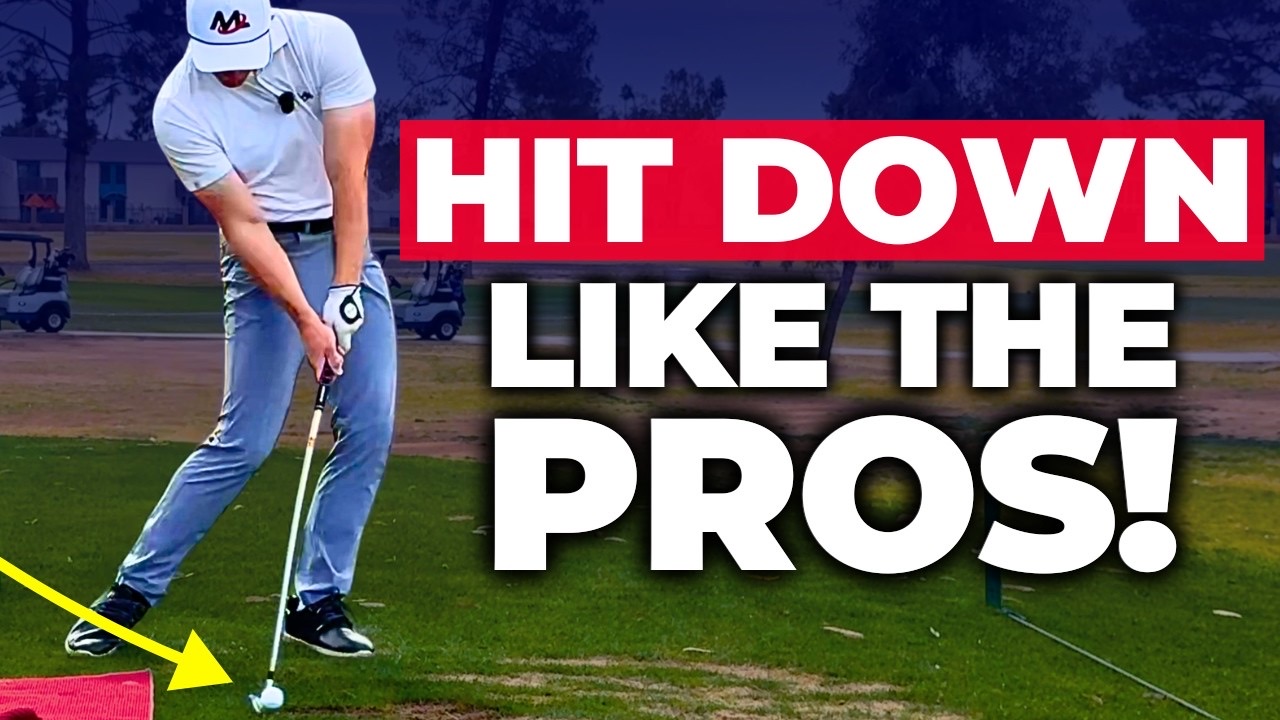
Chunking irons is no doubt demoralizing. The chunk has got to be one of the most frustrating shots in golf. And we’ve all done it, myself included. No one is fully immune…
That little white ball is sitting on the ground waiting to be struck and time after time you find yourself hitting the ground inches behind it. But why is that? The pros don’t seem to have as big of an issue with it. So what can we do, simply, to ensure more consistent ball first contact? And give us a divot after the ball, allowing us to stop chunking irons so frequently?
So we can finally quit doing this…

Well, in this step-by-step blog (and also in the video above) I am going to break down the sneaky reason so many golfers are constantly hitting behind the golf ball. Plus, you’ll see exactly how to hit down on the golf ball the right way, just like the Tour Pros – giving you simple mechanics and proven drills to help you compress, and flush your irons more repeatedly during your next round.
How Pros Actually Hit the Ball First (For Great Iron Play)
So if you want to improve your ball striking with irons, you first need to understand what the elite players are actually doing time-after-time to start their divot at least at, or after the moment they’re making impact with the golf ball. For example, see Tiger Woods (one of the great iron players of all time) below demonstrating this pro level strike.

An important first understanding: an iron is a tool that has loft, and is designed to be driven down through the ball with some level of shaft lean and reduced dynamic loft. You’ve probably heard, “you don’t hit up on your irons”? This is true.
The best players are hitting down on the golf ball, reducing their dynamic loft and presenting the club face to the back of the ball typically before ground interference. But maybe you are already “hitting down”, but you’re still not having much success… Well, there’s more to it than just down.
The Sneaky Reason Amateurs Are Hitting Behind the Ball
So, the real key to becoming a better ball striker isn’t just trying to “hit down”. In fact, I bet you’ve tried that already and had mixed results. Just because you feel like you are hitting “down”, doesn’t guarantee you’ll strike ball first. There is something more to it…
See, the real secret is actually learning to move the bottom of your swing arc (or the low point) forward! If you think of the golf club swinging on an arc, pushing the bottom of that arc forward of the ball creates the downward angle of attack you desire, for free (see image below).

If your low point is at or behind the golf ball, you’re simply coming in too shallow. This leads to fat shots, thin shots, and poor contact. You’ll also not achieve the most desirable impact conditions for optimal spin like you’d see out of the Tour Pros.
Quite simply, most amateur golfers struggle with shots off the ground because their low point is just too early. Understanding this simple science will not only help your understanding, but also narrow your intentions and lead to better performance.
It’s Not Just About a Downward Angle of Attack
Now you know that it’s not just “hitting down”. In fact, this thought could be wrecking your swing. Just think, if you are trying to forcibly maneuver the club more downward out of the top, there’s a pretty good chance you’ll come in steep, over the top, and take a massive divot. I’d like to think there is a better way.
To actually hit the ball like a pro, you need to visualize the club head moving on a circle. For most golfers, we know that circle bottoms out too early. To fix this, you must figure out how to get the low point or the bottom of the arc more in front of the ball. This will give you that downward angle of attack for free and lead to more flush shots!
Master Your Circle
See the image below where I’ve surrounded myself with a circle. I’ve also highlighted one side of the circle behind the golf ball (and my alignment stick) in red to denote where most amateurs energy is, and where they are bottoming out. As I see it, most golfers are unfortunately “ball bound” and not freely moving through the strike. And in my experience this makes the swing feel tight, nervy, and more unpredictable––it’s basically no longer a “swing”.

No doubt, this is a recipe for even more thin shots and chunks. I also find it makes students almost jolty at impact, causing wrist conditions to break down (like a scoop) and early extension. Again, I’d like to think there is a better way, a way in which we don’t hit at the ball, we collect the ball, and the ball just gets in the way.
Now look at the other image below demonstrating what I consider to be the proper approach. The front side of the circle in now highlighted green as I’ve moved the energy out front and the low point is forward. This is more free and what you’d see from the pros, giving them compression and power.

Change Your Intentions
So if you want to strike golf balls off the ground with more confidence, you have to change your intention. The golf club is a tool designed to strike the ball with a downward angle, yes. But from here on I’d like to challenge you to think of that downward angle as a byproduct of getting your low point forward of the golf ball.
Whether you are using a wedge, short iron, long iron, or even fairway wood, this principle remains the same. You need to move that low point somewhat forward. This is what the Tour Pros are actually doing to strike it so consistently off the ground.
For you golf data junkies, check out the PGA Tour and LPGA Tour Trackman averages (from Trackman Golf) which further prove these points. While the averages for low point are not provided (generally 3-6 inches in front of the ball), remember, you cannothave a downward attack angle without a forward low point. So, if you are seeing, say a 0 or +1 AOA with your 8-iron when practicing, you’re probably doing it wrong, and your low point is too far behind.


What I really love about this low point focus is that it becomes less about a static position and the white ball just sitting there on the ground, and becomes more about how the club and you (the golfer) continues to move through impact. Keyword: through. Let me explain…
Practice Swings Can Make or Break You
So now that you have the understanding of how to properly create ball first contact, you’re probably asking, “how do we practice it?” and “how do we improve it?”. Well one often overlooked key is how you take your practice swings.
We can all agree most amateur golfers (and pros for that matter) take “air swings” or practice swings before their actual shot. But, I often see a distinct difference in how it’s done. Oftentimes I see amateurs taking practice swings where the bottom of their arc is at or even behind where the golf ball would be laying in their arc. To me, this is a huge no-no!

Instead, make the bottom of your practice swings several inches forward of where the golf ball would be (just like Jon Rahm above). Watch the best players—their practice swings always bottom in front. So make this small adjustment yourself, it could be a lightbulb moment type of easy fix! I’ve seen this simple practice help many golfers to free up their swings and achieve ball first contact more consistently (all with less effort).
The #1 Drill to Fix Your Iron Play Right Now
The next golf drill I recommend is about as simple as it gets, yet it is a “tried-and-true drill”, and a proven method for improving low point and strikes. And it’s even used by Tour Pros.
To start this drill, all you will need is a golf towel. This will be our training aid for today. Place the towel on the ground several inches behind the ball. Check out Chris Gotterup of the PGA Tour below for example as it’s a golf drill he uses a lot.

If you are doing this golf towel drill for the first time, I recommend starting with the towel about six inches back and maybe with just small punch shots before graduating to a fuller swing.
The goal is simple: strike the ball without catching the towel on your downswing. If you have an overly shallow or upward arc, you will snag the towel every time (unless of course you miss everything or top the ball). The hope is the towel over time becomes an afterthought.

To avoid the towel and strike it like a pro, you must move the low point forward, and create that downward angle of attack. This golf drill forces you to do that.
As you gain more confidence, you can move the towel closer—perhaps only four inches behind the ball. This forces an even more precise impact position. This ensures the club is moving through “empty space” and not getting interfered by the ground before it makes ball-first contact.
It’s one of the best golf tips for anyone struggling with thin shots or fat shots. It seems almost too simple, but it works and just makes sense!

Pay Attention to Your Turf Interaction
When you are at the golf course or on the range, you must be very aware of your turf interaction. If you are hitting balls off grass, look at where your divots start and end. Keep an eye on how deep or shallow they are. For example, maybe you are a picker or maybe you are a digger…
Grass and turf conditions can vary. Sometimes it’s very firm and other times grainy and wet, so divots oftentimes vary (even for Tour Pros). But what truly separates the men from the boys is where the divot begins. The best golfers have divot patterns that are well ahead of the ball, indicating a proper downward strike.
And for those of you who say hitting off mats is a waste of time or even counterproductive, you should still be able to feel where the club bottoms out. If you aren’t aware of this, then rest assured it’s going to be very hard to become the ball striker you want to be. You have to develop the feel for where the club head meets the ground to improve your iron play.
How to Really Level Up Your Ball Striking
To really challenge, and at the same time really improve your ball striking, try hitting balls directly out of an old shallow divot. While this sounds counterintuitive, it forces you to move the low point forward even more to create a solid strike. There’s not much room for error.
You’ll often see pros practice out of fairway bunkers for the same reason. You could even draw a little line in the sand with an alignment stick to see if your divot is in front of the line. These “bad lies” require you to strike the ball first with a forward low point. If you can repeatedly hit a clean shot from a divot or fairway bunker, I promise you your full swing is on the right track. Check out LPGA Tour great, Lydia Ko below as she hits a pure iron shot from the sand in her practice.

3 Golf Swing Mechanics to Move Your Low Point Forward
So outside of drills and practices, you may be wondering “what can we do in our swing to help create these dynamics at impact?” Well, first I should preface this by saying that these mechanics are all deserving of their own videos/blogs and I won’t go into too much detail. To me the focus of this blog is meant to be low point and our intention…
But because we all love diving deep into the swing, I’ve listed three main ingredients here needed for the recipe to properly hit down on the golf ball. They include:
- Weight Shift – think of this as more of a combination of where your weight, mass, and pressure are through the strike. It’s important to note that it’s typically best to have both the upper body and lower body relatively stacked up as to avoid sliding and tilting which can make getting ball first contact more difficult. Similarly, leaving your weight/pressure on your back foot and trail leg can also be problematic when hitting shots of the ground, especially with shorter clubs.
- Rotation – if your chest, hips, and even shoulders are overly closed off at the moment of impact, this can oftentimes lead to the club bottoming behind the golf ball. Unwinding can help move the bottom of the arc more forward and shift the swing path to more neutral.
- Wrist Angles – if you are throwing, casting, scooping, or flipping your hands and wrists at the ball or even out of the top of your swing, then good consistent contact is practically impossible. A common issue for golfers is trying to scoop the ball into the air, which leads to poor contact and inconsistent strikes. Many players mistakenly believe that they need to help the ball into the air, which leads to a tendency to scoop rather than hit down on the ball. With proper wrist conditions, shaft lean becomes much easier to achieve. Golfers often fail to get a proper downward angle of attack because they do not maintain forward shaft lean at impact, which is essential for solid strikes. Learn to have that trail wrist in some amount of extension at impact for compression and to hit irons pure.

Check out Adam Scott above as he demonstrates these three variables, moving from setup (left) to impact (right). Notice he’s unweighted his trail leg, he’s unwinding his middle, and he has some wrist angles for shaft lean at impact. A downward angle of attack is essential for crisp iron shots, which requires proper weight transfer and body positioning as exemplified by Adam Scott here.
When these three ingredients work together, the golf club naturally bottoms out inches in front of the golf ball. Not to mention you’ll be far less likely to make wild moves and compensations in your swing, like early extension. Using an impact bag to train your “hit” can also be helpful for recreating this powerful look. Note, this isn’t about “driving” the club into the ground with brute force; it’s about using these important fundamental movements to let the swing arc do the work for you.
Sam Snead Says Do This to Flush Your Golf Shots!

“You don’t hit at it, you hit through it.” Those are some simple, yet powerful words from the great, Mr. Sam Snead. I can’t think of a better statement from one of the legends of the game.
What I hear from Sam Snead here is that when your intention is to move the low point forward, the ball simply becomes a point in time during your golf swing. This is how we strike the ball correctly. You in turn hit through it, rather than at it. And I believe it’s this mental shift that will help you strike the ball with professional-grade compression.
Think of the impact position not as a destination, but a doorway. By focusing on moving your energy and swing a few inches in front of the ball and through to your finish, you naturally achieve all the impact goodies for free, like ball first contact, compression, forward shaft lean, and a a downward angle of attack.
Swing the Club Head with Confidence!
To start hitting better golf shots off the ground consistently, you must take these practice drills to the golf course. Use the towel drill to eliminate fat shots and use my other simple tips (like on practice swings) to monitor your low point.
Don’t be afraid to hit golf balls out of a shallow divot, a tight lie, or even a fairway bunker to sharpen your impact position. These exercises are designed to give you more confidence under pressure, and will make the good lies that much easier. Pretty soon your impact position might even look like Dustin Johnson, and the many other Tour Players shared in this blog and in my video.

For More Golf Tips…
So now you know how to hit down on the golf ball (the right way). Now you can get to work on the things that matter so you can greatly reduce thin shots and chunks from your game. Mastering your low point is one of the first steps towards more consistent ball striking, but the journey to a truly athletic swing doesn’t have to be a solo effort…
I’m Henry Fall, and I’m dedicated to helping golfers of all skill levels through a personalized approach blended with our athletic swing principles. Whether you are a local here in Mesa, Arizona, or a golfer on the other side of the world, I am here (along with our full team at Milo Lines Golf) to provide the roadmap you need to strike the ball with more confidence. You book 1-on-1 golf lessons in person at Dobson Ranch Golf Course where I offer comprehensive coaching tailored to your unique swing. Or join us for a golf school for an unforgettable experience!
And, for those who can’t make it to the desert or would like an actionable step-by-step program, join our Online Academy today for instant access to our full swing playbook, The Athlete’s Swing® plus personalized swing analysis every 2 weeks! Don’t let another season pass you by. Book a lesson, attend a school, or join our Online Academy today and let’s level up your golf game.
Leave a Reply